Youth.cn Qingdao October 27 (By Li Huaxi)
Sino-German Ecopark in Qingdao West Coast New Area has won 12 titles such as pilot of national low-carbon city, pilot of smart city, comprehensive standardization demonstration zone, new energy application demonstration zone, smart manufacturing demonstration zone, etc. It has also won China Human Settlements Award and was rated a Top 10 classic case for industry-city integration.
In recent years, the Ecopark follows the concept of coordinated, integrated, green and ecological development in planning and management. New energy saving technologies and buildings are widely applied in its development. An idyllic city model is being developed where people live and work comfortably. This is a productive and effective effort to explore a path of sustainable development for future cities.

Delegations visiting the Ecopark
Photo by Li Huaxi, reporter of Youth.cn
Han Zhe, director of City Management and Environmental Protection Division of Planning and Construction Bureau under Qingdao International Economic Cooperation Zone Administrative Committee says that, a planning management and control system has been set up, an ecological control sensitive area has been designated, and a red line has been drawn, all to conserve resources and energy, reduce pollution, and protect the environment to the greatest extent, so as to realize the goal of intensive, efficient and sustainable utilization of land and space and enable healthy and sustainable development of the Ecopark. The original topographical features, as well as 66.25% of the existing roads, 80.14% of the water bodies and 58.27% of the forest land have been preserved and utilized. 66.25% of the existing roads, 80.14% of the water bodies and 58.27% of the forest land have been preserved and utilized.
Han Zhe introduces that, in order to extensively apply new technologies, low-energy buildings and promote green construction in the Ecopark, a goal of 100% green construction has been set, which means that all the construction projects are forbidden to do damage to the original topography, vegetation, water system and texture,.Measures such as temporary soil mulching, categorized recycling of construction waste, noise and light pollution control have been taken in the process of development and construction and scheduling, quality control, environmental protection, investment, safety, innovation and green construction are all managed in a holistic way.
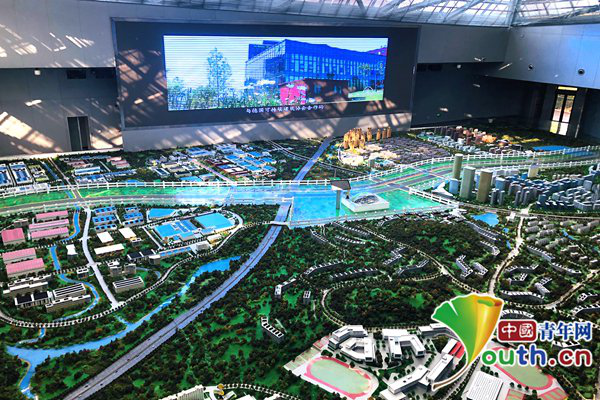
Rendering of the Ecopark
Photo by Li Huaxi, reporter of Youth.cn
Besides, the Ecopark promote green and energy-saving buildings. On top of implementing the national green construction standards, the Ecopark has introduced green building standards such as DGNB and passive house standards, and widely promotes the construction of passive green buildings featuring super-low energy consumption.
By the end of 2018, demonstrative passive houses with at total floor area of 50,000 m2 will be constructed, cutting carbon emission by 1,300 tons. By the end of 2020, demonstrative passive house communities with a total floor area of 300,000 m2 will be constructed, cutting carbon emission by 7,600 tons. The Ecopark has also participated in the formulation of the standards for passive green buildings with super-low energy consumption by the Ministry of Housing and Urban-Rural Development.
“We have signed a cooperation agreement with Zhengtai New Energy Group from Zhejiang. The photovoltaic power generation project in the Ecopark will be run in accordance with the contract where 100% of the building in the park will be managed in a unified way”, Han Zhe introduces. The Ecopark will also ensure comprehensive utilization of clean energy and renewable energy. Demonstration projects for geothermal energy application, distributed solar energy photovoltaic power generation, distributed energy system projects and ubiquitous energy network are being constructed.
The 4894kw distributed solar heat collection project has been completed at Frey Community and German Enterprise Center. The project can provide reliable domestic hot water for residents in the 15 communities and companies in German Enterprise Center.
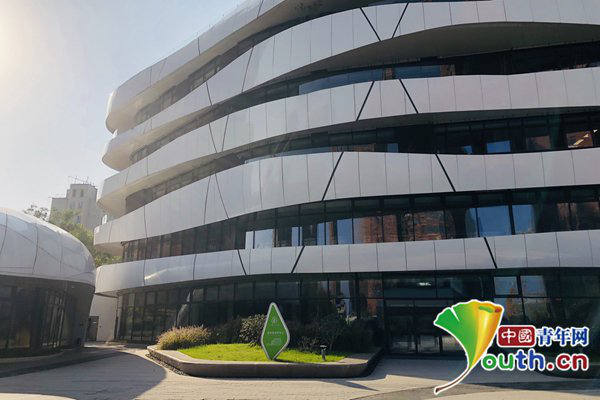
Passive house in the Ecopark
Photo by Li Huaxi, reporter of Youth.cn
Geothermal heat is applied at the experience and operation center, ecological technology exhibition center, German Enterprise Center, and Sino-German Primary School at Sino-German Ecopark. The installed capacity is about 1,500 kilowatts. The geothermal heat system for passive house technology experience center, Sino-German Vocational Education Capability Center is under construction.
Han Zhe says, “The first ubiquitous energy network (UEN) in Shandong has been connected to the grid. No. 1 and No. 2 UEN Stations are connected to the grid; No. 4 UEN Station has been completed and put into operation. UEN has successfully provided combined cooling-heating-electricity supply for German Enterprise Center, Frey Community and industrial projects.”
Moreover, the Ecopark promotes the development of the green and ecological low-carbon platform. In order to facilitate the realization of its green, ecological and low-carbon goal, the Ecopark has drawn advanced domestic management experiences and set up Qingdao Sino-German Ecopark Green Ecology Development Institute to conduct whole-process green and ecological technical examination on all the projects in the Ecopark.
It is learned that the Asian City Capacity Center jointly initiated by the Ecopark and Siemens has been launched in 2017 to leverage the Siemens Global City Capacity Center network and the City Performance Tool it developed and conduct research on sustainable development key performance and low-carbon practices. A feasible roadmap for implementation will be made by assessing the detailed carbon-emission conditions in various areas in the Ecopark and analyzing the potential of carbon emission and controlling measures.
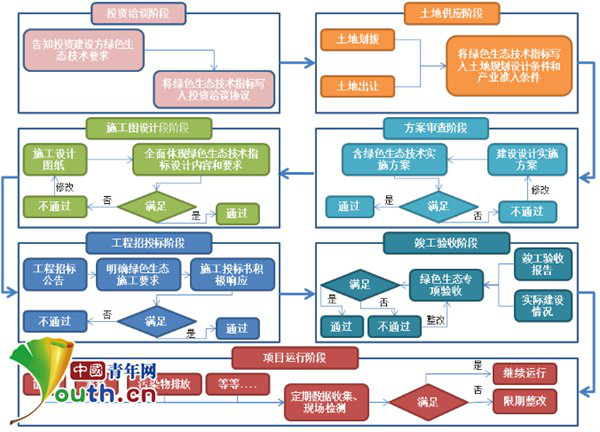
Qingado Sino-German Ecopark green and ecological construction management and control process chart
Han Zhe told the journalist that, “measures for energy saving and emission reduction, such as incentives, punishment, regulations and bylaws, are introduced according to the situations in different areas. It has been shown that the sustainable development that the new generation park pursues doesn’t come at the cost of economic benefits. Sino-German Ecopark strives to be a frontrunner in low-carbon development among domestic parks and zones by sticking to its plan and strengthening the application of innovative technologies in key areas. The Ecopark aims to cut emission by 373,000 tons by 2020 as compared to the conventional development model. Per capita carbon emission intensity will be lower than the national average level or even that of developed countries”. This is a testament to the successful cooperation at the city level between Chinese and German governments.