
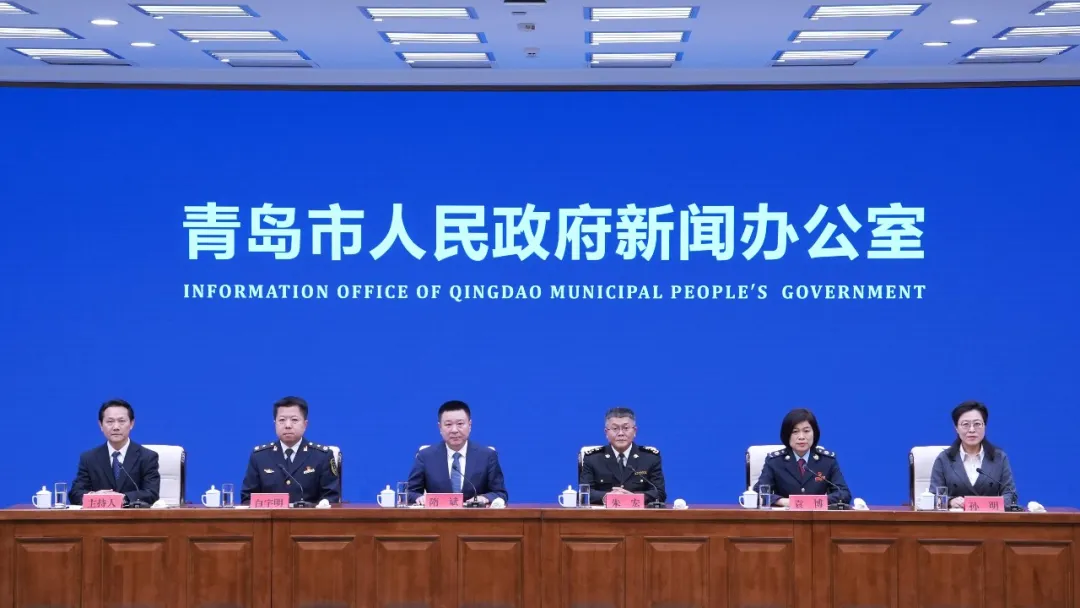
On December 26, the Information Office of Qingdao Municipal People's Government held a press conference on the “2025 High-Efficiency Institutional Innovation Outcomes of Qingdao FTZ”. Sui Bin, Member of the Working Committee and Deputy Director of the Management Committee of Qingdao FTZ, and Member of the Leading Party Members' Group of Huangdao District Government, introduced the main outcomes of the 2025 high-efficiency institutional innovation outcomes of Qingdao FTZ. Attending the press conference and answering questions from reporters were: Zhu Hong, Member of the Party Committee, Deputy Commissioner, and First-Level Inspector of Qingdao Customs District P.R. China; Bai Yuming, Member of the Leading Party Members' Group and Deputy Director of the Shandong Maritime Safety Administration; Yuan Bo, Member of the Party Committee and Chief Economist of the Qingdao Tax Service; and Sun Ming, Director of the Administrative Services Division I and Level I Division Rank Official of the Qingdao Municipal Bureau of Administrative Services.
As a national pilot platform for reform and opening up, Qingdao FTZ has, since the beginning of this year, deepened the implementation of the strategy to upgrade pilot free trade zones. Through close collaboration with various departments, it has explored and developed 31 high-efficiency institutional innovation outcomes. Among these, one has been elevated to a national institutional norm, five have received innovative filing or promotion as exemplary cases by national ministries and commissions, and 25 have been promoted or recognized by the provincial government or provincial-level departments. Overall, these outcomes mainly exhibit three key characteristics: first, a stronger emphasis on “pioneering innovation”. Over half of the outcomes represent nationwide firsts or leading explorations, with several reforms addressing institutional gaps and bottlenecks to achieve breakthroughs “from zero to one”. Second, a clearer focus on “practical effectiveness”. Guided by problem-solving and demand-driven approaches, Qingdao FTZ has precisely addressed pain points and blockages faced by market entities in areas such as cross-border trade, production and operation, and factor acquisition, leading to a stronger sense of gain for enterprises. Third, a deeper exploration of “leadership”. By proactively aligning with international high-standard economic and trade rules, Qingdao FTZ has made systematic innovations in fields such as green and low-carbon development, the marine economy, financial openness, and digital governance, accumulating new experience for the development of new quality productive forces and high-level opening up.
Over the past year, Qingdao FTZ has focused on upgrading convenience and building a new ecosystem for cross-border trade. It has carried out comprehensive, in-depth reforms in key areas such as cargo clearance, tax services, and regulatory alignment to streamline trade processes, reduce costs, and improve efficiency. Clearance services have been continuously optimized and expedited. A reform in the "one-to-many" model for import manifest verification and cancellation has been implemented, shifting from a "one-to-one" to a "one-to-many" approach. This has reduced logistics time by more than two days and saved RMB 200–300 per manifest split. A pioneering national model for inbound supervision of "recyclable packaging materials" has been introduced, cutting clearance time by 7–10 working days per shipment and expected to save over RMB 85 million annually for nearly 400 enterprises in the Qingdao customs area. The "Yang Jie Tong" model for transporting laboratory testing samples was the first of its kind in the country, reducing average inspection delivery time by 30% and saving about RMB 200 per container in logistics costs. An innovative smart inspection model for inbound bulk grain was developed, cutting surface quarantine time from half a day to one hour and increasing unloading efficiency by 66%. Information sharing has contributed to cost reduction and efficiency gains. The innovative "Tax·Customs Credit Link" AEO shared empowerment model has facilitated both customs clearance and tax rebates for high-credit enterprises. A nationally pioneering model for mutual recognition of origin certificate management information has been implemented, enabling "one-time review, one-time verification, and integrated risk prevention" for certificate processing, saving 1–10 days per certificate in material preparation or verification waiting time. A classified and tiered tax service management model for refined oil trading enterprises was explored for the first time, achieving precise profiling, dynamic supervision, and differentiated services to safeguard the legitimate rights and interests of compliant enterprises. Breakthroughs have been made in aligning with international rules. An innovative classification management model for lithium battery exports has shortened logistics time for small lithium batteries by 62.5%, reduced logistics costs by RMB 5,000 per container, and saved RMB 1 million per shipment for energy storage systems. A pioneering national model of "pre-shipment testing" for tires has facilitated exports, achieving zero returns and zero destruction of tested tires at Saudi ports while reducing quality dispute risks by over 90%. A new mechanism for regularized joint boarding inspections of international vessels has been innovatively established, reducing inspection time by 2–3 hours and saving large container ships RMB 50,000–100,000 in port fees per voyage. A nationally pioneering simplified declaration model for inbound and outbound international vessels has been implemented, enabling "one-time reporting" for docking and departure, "real-time sharing" of processing progress, and "seamless supervision" of boarding and disembarking inspections, and reducing vessel waiting time in port by 67%.

Over the past year, Qingdao FTZ has focused on service optimization to shape new advantages in its business environment. Centering on the entire lifecycle of enterprise operations, it has deepened reform and exploration in areas such as market access and operation, factor supply, and dispute resolution, enhancing the precision and intelligence of government services. Government management reforms have been deepened and expanded. The zone took the lead nationwide in pioneering a standardized reform of agency services for business registration and licensing, promoting the regulated development of the agency service industry and filling a domestic policy gap. This initiative was elevated to a national institutional norm in September 2025 after pilot implementation. It pioneered a nationwide pre-litigation mediation system for tax-related disputes, effectively safeguarding the legitimate rights and interests of taxpayers and reducing the cost of rights protection by lowering the threshold for dispute resolution. The zone innovatively introduced an "seamless processing" system for construction land planning permits and fee payments, eliminating the need for applications, materials, or in-person visits in two procedural steps and improving efficiency by 97%. Factor support has become more robust. The zone pioneered a nationwide model for financing with bonded standard warehouse receipt pledges, enabling online pledge financing for bonded standard warehouse receipts of TSR 20. This helped two enterprises secure financing totaling RMB 1.9 million. It implemented the country's first insurance policy for patent-intensive products, providing science and technology enterprises with full-chain risk coverage featuring lower premiums, higher coverage, and more comprehensive protection. The zone also took the lead in launching a pilot for customs tax payments via digital RMB, offering businesses a faster and more secure payment option. Specialized industry services have been precisely empowered. Qingdao FTZ innovatively implemented reforms to facilitate the import clearance of medicine and food homology (MFH) goods, systematically addressing the challenges faced by non-pharmaceutical enterprises in importing such products. Eleven pilot enterprises imported 8,709 tons of goods with a trade value of approximately RMB 25.93 million. It introduced a model for improving the efficiency of underutilized land in industrial parks, creating a new urban governance framework based on co-consultation, co-construction, and co-sharing. This initiative upgraded 26 old industrial buildings, attracting over 3,000 registered enterprises with registered capital of RMB 60 billion. The zone also pioneered a new model for crew credit management services nationwide, effectively addressing issues such as the lack of credit information and frequent breaches of trust in the crew market. To date, 184 companies have completed credit information registration, providing 436 crew members with targeted job placement services.
Over the past year, Qingdao FTZ has focused on distinctive development, fostering new drivers for collaborative openness. Building on its strategic positioning and unique strengths, it has dedicated efforts to fields such as the marine economy, green and low-carbon initiatives, and regional coordination, forming differentiated and leading development advantages. The modern marine economy has seen an upgrade in capacity. The zone advanced pilot standardization for smart and green port services, leveraging standardization to enhance intelligent cargo tallying services and improve port service quality and efficiency. An innovative joint prevention and control supervision mechanism for import and export hazardous goods was established, effectively raising the level of shared governance in port safety. This increased the efficiency of unpacking domestic hazardous goods by 200% and reduced the clearance time for foreign trade hazardous goods by 50%. The zone took the lead nationwide in implementing a "one-stop" reform for maritime vessel operations, improving processing efficiency by 85.1% and reducing required materials by 70.4%. Tangible results have emerged in green and low-carbon development. The zone pioneered a nationwide registration service mechanism for green and low-carbon business entities, generating 1,371 items of self-disclosure content and effectively enhancing registration convenience for green and low-carbon enterprises. It innovatively built a diversified ecological civilization education system, deepening ecological consensus. The Qingdao Sino-German Ecopark was selected for the "C40's Green and Thriving Neighborhoods Case Library". An integrated model for green energy conservation and carbon reduction in container ports was introduced, providing an industry benchmark for the green construction of container ports. The Qianwan South Port Area was recognized as one of the first national "Five-Star Green Port Areas" for containers. The pattern of collaborative and innovative development has broadened. The zone pioneered a nationwide model of “pre-approval and on-demand processing” for certificate-of-origin issuance for logistics enterprises engaged in consolidation and distribution. This helped enterprises export goods worth over RMB 660 million under RCEP preferences, with benefits amounting to nearly RMB 10 million. It took the lead nationwide in creating a new in-transit supervision model for transit goods, reducing waiting time at railway hubs in destination ports by six days per container and cutting logistics costs by RMB 400. Clearance time at exit ports was reduced by 85%, further advancing the logistics corridor construction in the Yellow River Basin. In collaboration with Yanggu Economic Development Zone, Qingdao FTZ introduced reforms to facilitate the export of copper by-products, achieving the first export transaction for Liaocheng City. Partnering with Rizhao Comprehensive Bonded Zone, it innovatively developed a multimodal transport model for cold chain logistics, opening a new cold chain logistics channel from the Shandong Peninsula to inland southwestern regions. This reduced transport time by 16 days and lowered overall costs by 27%. Together with Linyi Comprehensive Free Trade Zone, Qingdao FTZ established a high-capacity platform to strengthen cross-border trade, facilitating the launch and operation of northern China’s first AliExpress Cross-Border E-commerce Industrial Park. This initiative resulted in the opening of over 120 new stores, generating import and export volumes totaling RMB 350 million.
The "source and vitality" of institutional innovation have been effectively translated into development momentum. From January to November, amid a complex and volatile external environment, Qingdao FTZ achieved a 6.6% year-on-year growth in foreign trade import and export, accounting for 21.1% of the city's total. Sales in wholesale industries above a designated size grew by 5.24% year-on-year, representing approximately 25% of the city's total. General public budget revenue increased by 10.1% year-on-year, with tax revenue constituting 94.7% of the total. Both the growth rate and tax proportion ranked first in the city, demonstrating the zone's significant role as a new hub for opening up.